
Best Survival Machetes | 9 Field-Tested and Approved Machetes I’ve Used in the Real World
Updated August 2026: I’m a machete nut. I’ll just own that right up front. If there’s one tool I’d call the most legit do-everything tool in the outdoors world, it’s a machete, and I’ve got a real collection of them to prove it.
This isn’t a niche interest in my house either. My older boys grab a machete just as often as I do, whether we’re camping, hiking, cutting in a new mountain bike trail, or just knocking out yard work around the property. It’s become the default tool we reach for before we reach for anything else.
For this list, I asked myself a specific question: if I could only have one tool, one machete, and it was a real life-or-death survival situation, which one would it be? Sure, if I had my full choice in an actual survival scenario, I’d rather have a satellite phone to call for help or a firearm for hunting and protection.
But if those two are off the table, a machete is what I want in my hand over a survival knife every single time. It does more, it covers more ground, and if you can only carry one tool, it’s the one that earns its keep the widest range of ways.
Every machete on this list, I own or have owned. I’ve used every single one of them in the field extensively, not just handled them in a store or read a spec sheet. That’s the bar for making this list. The one exception is the TOPS, which I gifted to a friend last year after years of using it myself, but I stand by everything I say about it here from that time carrying it.
Condor Tool & Knife Mountain Pass Machete

The Workhorse That Lives By My Workbench
Street Price Around $130
What puts the Mountain Pass at the top of this list comes down to two things: blade shape and weight distribution. The geometry on this thing is exactly what you want out of a real chopper. The weight sits forward, right where it needs to be to let the blade do the work instead of your arm, and the convex grind behind that 15.5″ of 1075HC steel bites deep and holds up swing after swing without rolling or chipping. This isn’t a machete that looks like a chopper. It actually chops like one.
That’s exactly why this is the one that lives in my garage, hung right next to the workbench, in easy reach for whatever job comes up. It’s not tucked away in a safe or a display case. It gets grabbed constantly, for clearing brush, breaking down branches, general yard work, whatever needs a blade with real leverage behind it. A tool that earns a permanent spot within arm’s reach of your workspace has already told you everything you need to know about how much you trust it.
The natural canvas Micarta handle is exactly the kind of handle material I talked about earlier: it holds up to real use, feels good in the hand over a long session, and looks better the more beat up it gets. The included brown leather sheath is proper leather with a real belt loop, not the nylon or Kydex stuff I’ve cooled on over the years, and it’s built to actually carry this thing on your body, not just protect it in a bag.
If you’re building a bushcraft shelter and need to process real material fast, this is the tool I’d hand you. At around $140, it’s not the cheapest machete on this list, but it’s the one I’d replace first if something happened to it, which tells you everything about where it sits in my collection.
Check Out My Best Condor Machete List, the Mountain Pass is There
Condor Tool & Knife Amalgam Machete

The One I’d Grab If I Could Only Have One
Street Price Around: $125
I know I just told you the Mountain Pass is the best machete I own, and I meant it. But if you asked me the actual survival question, the one tool, one machete, life-or-death scenario I framed this whole list around, my honest answer is the Amalgam. Those are two different questions with two different right answers, and this is the one that wins the second one.
The Mountain Pass is a dedicated chopper. The Amalgam is a genuine do-everything blade, and that versatility is exactly what matters most if you truly only had one tool. The drop point profile gives it real precision for detail work, carving, preparing game, anything that requires actual control instead of just swing power, while the full tang 1075 carbon steel construction means it doesn’t back down from harder chopping and clearing tasks either.
It’s not the best at either extreme the way a dedicated chopper or a dedicated knife would be. It’s the best at doing both well enough that you’d never feel undergunned no matter what the day actually threw at you.
The walnut handle is contoured in a way that genuinely reduces fatigue over a long session, and it’s paired with full tang construction, which I’ve already told you is non-negotiable for me on anything I’d trust in a real survival situation. The full-grain leather sheath is handmade, built for actual belt carry, and it’s the kind of sheath that ages well instead of falling apart.
This machete has made it onto more than one of my lists over the years, including my Best Condor Machetes roundup, and that’s not a coincidence. At $121.53, it’s genuinely the best value-to-versatility ratio in my entire collection. If you can only own one machete, period, this is the one I’d point you to.
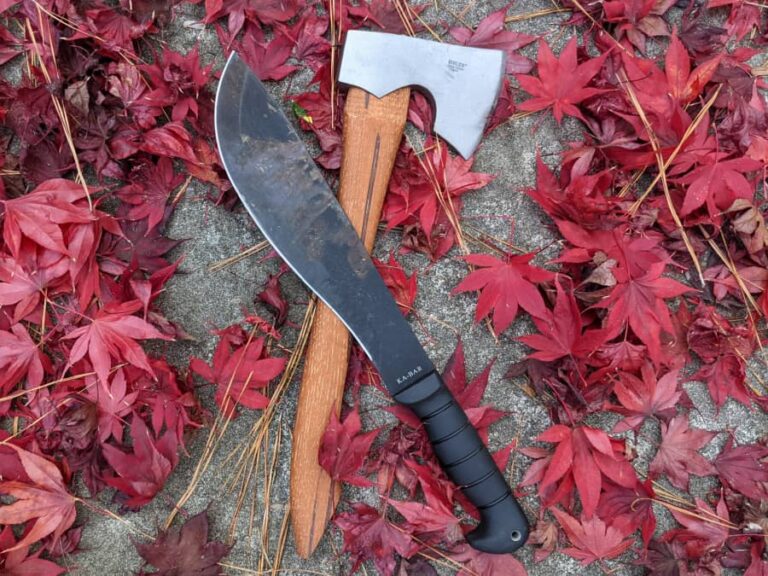
Ka Bar KA1248-BRK Cutlass Machete

Short Blade Big Attitude
Street Price Around: $90
This guy is a monster. It’s short compared to some of the others on this list, but don’t let the length fool you. It’s stout, heavy, and built for genuinely hard chopping work in a package that’s easier to maneuver in tighter brush than something with another five or six inches of blade.
The 1085 carbon steel takes an excellent edge. Out-of-the-box sharpness on this one is genuinely impressive, razor sharp straight from the factory with zero prep needed, and the recurve toward the tip gives it real bite when you’re pushing through dense brush or small limbs. The Kraton G handle is grippy and holds up well even when things get wet, which matters more than people think once you’re actually sweating through real trail work.
I do want to flag something honestly here, since I’ve been straight with you about my sheath preferences throughout this list. The spec sheet calls this a Cordura and leather combination, but in practice it reads mostly as a hard Cordura and plastic build, without much genuine leather presence.
It’s functional, and it does the job of protecting the blade and carrying it on your belt, but if you’re expecting a premium leather sheath to match the blade quality, temper that expectation. It’s the one place this machete doesn’t fully live up to the rest of the package.
Even with that gripe, this is one of my favorite all-around machetes, and it’s made an appearance on other lists of mine, including my Best Machetes for Clearing Brush article. At under $70, it’s a legitimately great budget blade that chops well above its price point.
The Ka-Bar Cutlass Made My Best Machetes for Clearing Brush List
Condor Tool & Knife Bushcraft Parang

Unbeatable Value for the Money
Street Price Around $90
This one’s popular for a simple reason: the price-to-durability ratio is hard to beat. At around $70, you’re getting genuine 1075 high carbon steel with a convex grind, and that combination holds an edge through real, extended chopping sessions without needing a mid-session touch-up.
The angled blade profile is where this thing earns its keep. It’s a genuine parang shape, curved and weighted for chopping and slashing through dense brush, and once you get used to the weight, and it does swing heavier than the roughly pound and a half it actually is, it moves through material with real authority. This is a legitimate camp and survival do-all tool, useful for clearing brush, processing wood for a fire, and general bushcraft tasks.
I do want to flag one thing honestly, since I’ve been straight with you about what I look for in a survival machete throughout this list. This one runs a hidden tang construction, not full tang. I told you full tang is non-negotiable for me on anything I’d trust in a genuine survival situation, and this machete is the exception to that rule. It’s held up fine in real use, and Condor builds it solidly enough that I haven’t had an issue, but if you’re strictly buying by that rule the way I generally do, know that going in.
The polypropylene handle is comfortable and grips well even as things get sweaty, and the ballistic nylon sheath does its job, though if you really fall in love with this one, it’s the kind of blade that’s worth upgrading to a proper tooled leather sheath down the line. At its price point, this is one you genuinely can’t go wrong with, and it’s earned its popularity honestly.
TOPS Knives Yacare Machete
Precision Over Power

- The fixed blade and drop point machete knife is made of 1095 RC 56-58 steel
- The fixed blade knife comprises 10.25″ blade length and 15.50″ overall length
- Drop point style of the blade is supplied with Black Canvas Micarta handle
- Includes a slim, durable Black Ballistic Nylon sheath with Belt Loop
- Can be used both for tactical, hunting and survival purposes
I gifted my Yacare to a friend last year after using it for years myself, so I’m speaking from real time carrying this one rather than what I have on hand right now. It earned its spot on this list regardless.
This is the shortest, most knife-like blade in the whole lineup, and that’s exactly the point. The drop point profile trades some of the raw chopping power you’d get from a Latin-style or parang blade for genuine precision. This is the machete I’d reach for when the task shifted from clearing brush to actual detail work: fire starting, carving, tool crafting, anything that needed real control instead of just swing power. It’s robust enough to still handle defensive needs or harder chopping in a pinch, but precision is where it separates itself from the rest of this list.
One thing worth noting: TOPS runs 1095 steel here instead of the 1075 I keep coming back to elsewhere on this list. 1095 pushes harder on hardness, RC 56-58 on this one, which means it holds an edge a little longer but comes with a slightly higher risk of chipping under real abuse compared to the tougher, more forgiving 1075. In years of use, I never had an issue with it, but it’s worth knowing the trade-off going in.
The black canvas Micarta handle is the same material family I trust across several machetes on this list, and it held up exactly as well here. The sheath is ballistic nylon rather than leather, which is a step down from my usual preference, but it’s slim and functional, and it did the job of protecting the blade through years of real carry.
At $214.90, this is the most expensive machete on this list, and I’ll say the same thing I said about it originally: you get what you pay for. This isn’t a budget pick, it’s a precision tool for people who want genuine control alongside real capability.
CRKT Kuk

The Perfect First Kukri
Street Price Around $50
This is a classic for a reason, and it’s the entry point I’d point most people toward if they wanted to try a kukri-style blade without spending real money to find out if they like the shape. At around $50, you’re getting a genuine RMJ Tactical design pedigree, since Ryan Johnson, the same guy behind CRKT’s tomahawk lineup, designed this one too, and that pedigree shows in how well it’s held together under real use.
The 65Mn steel is a mid-carbon Chinese steel, roughly equivalent to 1065, and it’s proven itself in a lot of budget machetes across multiple brands, not just CRKT. It’s not going to out-hold-an-edge the 1075 or 1095 steels elsewhere on this list, but it’s tough, it resists chipping under real abuse, and it’s easy to bring back sharp.
The recurve kukri shape channels material into the blade as you cut, which makes it genuinely excellent at clearing soft vegetation and brush, though it’s worth being clear that this is a kukri-inspired shape, not an authentic reproduction. If you’re expecting traditional Nepalese kukri geometry, look elsewhere. If you want a machete that borrows the best parts of that shape for real trail and yard work, this delivers.
Full tang construction backs up the injection molded handle, and under a pound of total weight means it swings fast and doesn’t wear out your arm on longer sessions, though it’s genuinely not a hatchet replacement for real heavy wood processing. Use it for what it’s built for, clearing brush, general camp tasks, light chopping, and it holds up beautifully.
I liked this one enough to give it a full dedicated writeup. If you want the deeper breakdown, check out my full CRKT Kuk review. At under fifty bucks with a lifetime warranty behind it, this is one of the easiest recommendations on this entire list.
Esee Jaraca Kukri

A Serious Chopper at a Serious Price
Street Price Around $105
I have to be upfront about something with this one: this used to be a genuine budget kukri pick, and after all these years, it isn’t anymore. At just over $100, it’s crossed into the same price territory as several other machetes on this list, and that changes the conversation around it a little.
Don’t listen to the fools on Amazon complaining about this one. It’s still an outstanding machete from a great company, but I’ll give you the honest trade-offs so you know exactly what you’re buying at this price point.
The blade geometry is thick and built for real impact, batoning through logs and splitting wood is where this thing genuinely shines, blasting through material that would make a thinner-edged blade work a lot harder.
Where it gives some of that back is in finer work. Cordage, live greenery, anything that wants a thinner, more refined edge is more of a chore with this grind angle, and you’d need to reprofile the edge with a belt sharpener if you wanted to push it in that direction.
The full tang walnut handle looks the part, with that classic stacked-wood aesthetic, but fit and finish can run a little rough on these, with visible gaps between the wood and the tang on some units and sharp, uncontoured shoulders that transmit more shock into your hand during hard chopping than a rounder, more ergonomic handle would.
It’s not a dealbreaker, and gloves help a lot here, but it’s worth knowing this isn’t the smoothest handle on this list if extended chopping comfort is your top priority.
The Cordura sheath is functional, but at this price, especially now that it’s climbed past the hundred-dollar mark, I’d have liked to see ESEE step up to a real leather option the way Condor does at similar price points. It gets the job done for now, but don’t be surprised if you eventually look at an aftermarket leather or Kydex upgrade down the line.
None of that changes the bottom line. This is still a serious, capable chopper with genuine 1075 steel and full tang construction behind it, and it’s earned its spot here through real use, not nostalgia for what it used to cost.
Cold Steel Barong Tactical Machete

Pure Chopping Muscle
Street Price Around $30
This is a recent addition to my collection, I picked it up last year, and man, is it awesome. I love the size and weight on this thing. It’s a bigger, longer beast than most of what’s on this list, and that extra length translates directly into more chopping power. Once you get it swinging, it moves through material with real authority.
The blade shape is inspired by the traditional Filipino barong sword, and that heritage shows in the belly and the forward balance point. The weight sits well out toward the tip, which is exactly what you want in a dedicated chopping tool, it lets the blade do the work instead of your arm.
The 1055 high carbon steel takes a genuinely sharp edge and holds it through real use, though like most high carbon steels, it’ll rust if you don’t wipe it down after use. The baked-on black matte finish helps protect the exposed steel and holds up well.
My favorite feature on this whole machete is the handle. It’s got a hooked pommel design that keeps it locked into your hand during hard, repeated chopping. A lot of machetes without that hook or a lanyard loop want to slip out of your grip the harder you swing, especially once your hand starts sweating.
This one just doesn’t. You can chop like crazy and it stays exactly where it’s supposed to be. That pommel hook also doubles as a striking or pommeling point if you ever needed it for something other than cutting, and the blade carries enough of a point at the tip to be genuinely useful if you needed a stabbing capability, something a lot of rounder-tipped machetes on this list don’t offer.
At around $35, this is one of the best value propositions on this entire list for pure chopping power. If you want a longer, heavier blade that rewards a real swing and won’t slip out of your hand no matter how hard you’re working, this is the one.
CRKT Halfachance Fixed Blade Parang Machete

Built for the Long Haul
Street Price Around $65
Ken Onion designed this one, and if that name sounds familiar, it’s because he’s an award-winning custom knifemaker with a long track record of putting out genuinely good working blades, not just gimmick designs. The Halfachance carries that pedigree well.
What sets this apart from the heavier choppers on this list is the weight. At just 1.28 pounds and a tenth of an inch thick, this is a light to medium machete built to actually be carried, not just swung around the backyard.
If you’re covering real distance on foot, hiking or backpacking somewhere the weight of your gear actually matters over miles, this is the one on this list that won’t wear on you the same way a heavier chopper will. It’s not going to replace a dedicated camping axe for serious wood processing, and it’s not trying to. It’s built to be practical to hike with while still handling real cutting and light chopping tasks along the way.
The 65Mn carbon steel takes an edge well and holds up under abuse. It’s the same steel you’ll find on the CRKT Kuk elsewhere on this list, and it’s proven itself across a lot of budget-friendly machetes for a reason: it’s tough, resists chipping, and comes back sharp easily. The black powder coat adds real corrosion resistance on top of that.
The handle is football-textured glass-reinforced nylon with a rubber overlay, genuinely comfortable and grippy, and it’s got multiple lanyard holes if you want to rig up a wrist strap or a two-point lanyard setup.
The street price is around $60; this is a genuinely reasonable price for what you’re getting, and CRKT backs it with their standard support. If you want a long-reach blade for trail use where you’ll actually feel every extra ounce over the miles, this is the pick on this list built exactly for that job.
What Actually Matters When You’re Buying a Machete
After owning nine of these and putting real years into using them, here’s what I actually care about, not the generic checklist stuff you’ll find on every other site.
Steel. I keep coming back to 1075 high carbon steel more than anything else. It’s not the steel that holds an edge forever, but it’s tough, easy to bring back to a working edge with a file in the field, and I trust it more than stainless options that look nicer on a shelf but chip or roll under real chopping work.
Handle material. I’ve used walnut, canvas Micarta, and textured polypropylene across my collection, and each has its place. Micarta and walnut feel better for extended use and look better doing it. Polypropylene is nearly indestructible and doesn’t care about weather. Full tang is non-negotiable for me. A partial tang is where machetes fail under real stress, and I’ve seen it happen.
Sheath. I’m not a Kydex guy for most of my outdoor gear, and machetes are no exception. I gravitate toward leather with a real belt loop, built to carry the tool on your body all day. A well-built nylon or Kydex sheath isn’t a dealbreaker though. What matters most is retention. If it doesn’t hold the blade securely, that’s a real safety issue.
Size and weight. There’s a sweet spot, and it depends on the job. Enough blade length and mass to actually chop, but not so much weight that you’re gassed twenty minutes into real trail clearing. The machetes on this list found that balance in different ways, some heavier for raw power, some lighter for extended use.
Blade shape. Latin-style blades chop well and are the most versatile, which is why you’ll see a few here. Kukri-style blades curve forward for more chopping momentum at the cost of finer control. Parang-style blades split the difference for dense brush without wearing you out. None of these is objectively best. It depends on what you’re actually doing with it.
Extra features. Saw spines, built-in fire starters, that kind of thing. I don’t put much stock in these as deciding factors. I’ve never once reached for a firestarter built into a sheath instead of the actual fire kit I carry separately. If the rest of the machete is solid, great. I wouldn’t buy a mediocre one just for the gimmick.
Why a Machete Beats Almost Everything Else in a Real Situation
I’ve cut trail with a machete on mountain bike routes where a saw would’ve taken three times as long. I’ve used one to clear deadfall off a hiking path, split kindling when I didn’t want to dig out a hatchet, and hacked back brush that had completely swallowed a section of trail behind the house. None of that is theoretical. That’s just what the tool has actually done for me and my boys over the years.
The reason I’d grab a machete over a survival knife if I could only pick one comes down to reach and leverage. A knife makes you get close to whatever you’re cutting. A machete lets the blade length and swing do the work, so you cover more ground faster with less fatigue, whether you’re clearing a path, building a shelter frame, or just breaking down brush that’s in your way. It chops, it slices, it can baton kindling in a pinch, and the size of it means a lot more of the work gets done in a lot fewer swings.
It’s also just a more honest self-defense tool than people give it credit for, not because I’m walking around expecting a fight, but because size and reach matter if you’re ever in a genuinely bad spot in the backcountry. That’s a last-resort thought, not a first one, but it’s real.
The bottom line is simple. A machete is the one tool on my belt that does the most jobs the best, across the widest range of real situations I’ve actually put myself in. That’s not marketing copy. That’s just what nine machetes and a lot of years in the woods with my kids has taught me.

Blair Witkowski is an avid watch nut, loves pocket knives and flashlights, and when he is not trying to be a good dad to his nine kids, you will find him running or posting pics on Instagram. Besides writing articles for Tech Writer EDC he is also the founder of Lowcountry Style & Living. In addition to writing, he is focused on improving his client’s websites for his other passion, Search Engine Optimization. His wife Jennifer and he live in coastal South Carolina.